Listen, Review & Subscribe
If you enjoy the episode, please leave me a review on your favorite platform!



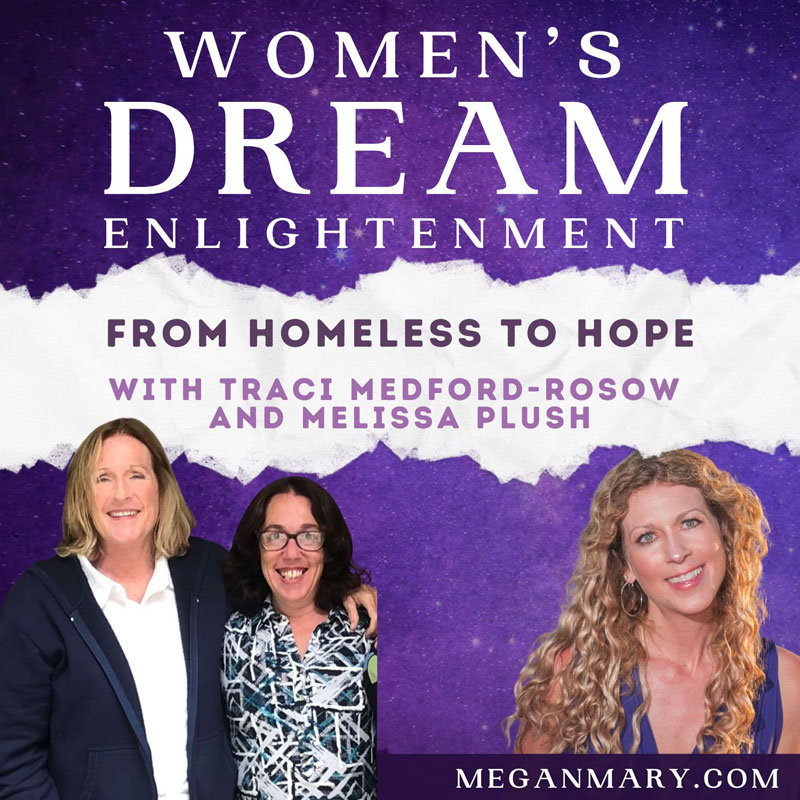
Women’s Dream Enlightenment | Episode 92
Traci Medford-Rosow is an intellectual property attorney and USA Today bestselling author of four books. She lives and works in New York City.
Melissa Plush, pen name Maggie Wright, is the co-author with Traci of the bestseller, Unsheltered Love: Homelessness, Hunger, and Hope in a City Under Siege and Chasing Light: Two Women, Their Mothers, and a Secret That Changed Their Lives. Maggie lives in Brooklyn with her partner and two beloved cats.
Unsheltered Love is a first-hand reported account of how the pandemic greatly exacerbated an already dire homelessness situation in New York City. It also provides an in depth look at one of the ten characters in the story—a homeless woman named Maggie Wright.
Chasing Light is a lyrical meditation on grief, memory, and the fragile beauty of everyday life. At its core, it is a story of resilience, forgiveness, and the transformational power of human connection. It sheds light on the overlooked realities of homelessness and addiction, while emphasizing the importance of compassion and second chances.
What does enlightenment mean to you?
To Traci, enlightenment is when “ when consciousness is identified with the divine self as opposed to the temporary ego construction.” I wholeheartedly agree with this astute insight. She goes on to say that you can come in and out of enlightenment, that it isn’t a permanent destination or state.
To Melissa, enlightenment arrived when she was “beneath rock bottom” and realized there was hope for her yet. She realized she didn’t have to stay in her terrible homeless situation and that she had a choice what direction her life was going to go.
Pandemic in the City
Traci and Melissa have a very unique story of how they met. Traci an attorney in Manhattan, was struck by the plight of the homeless during the pandemic of 2020. With her therapist husband, they set out to walk the streets of New York, passing out food and clothing. As Melissa puts it, “the city that never sleeps was silent.” Someone had to help.
The more Traci came to know the stories behind how the unsheltered found themselves without a pillow to lay their head on, the more she awakened. The lines began to blur between those who often disappear into the fray and herself. She began to shed her ego, loosen her identification with her egoic self, and step beyond the borders of her reality to show compassion and heart in a time when many were consumed with fear and judgment.
One of Traci’s “enlightenment portals” as she calls them, was not only that we are all connected, but that below the surface, we are all the same, and that her and Melissa were just two women, from two sides of the sidewalk.
The Back Story
Traci discovered that each homeless person had their own unique story of how they ended up on the street. Melissa’s began with complications from a root canal, leading her down the desolate path of opioid addiction and turning her predictable SUV-driving everyday mom lifestyle upside down until she found herself without a roof over her head. She says it was “ the most humbling, enlightening thing that could have ever happened.”
One of the common threads Traci and Melissa bonded over were the difficult stories of their mothers.
Traci’s mother’s story is one of abuse, addiction and suicide, while Melissa’s mother’s denigration scarred her identity as she grew up, altering her self-perception. This connection, and their realization of the victim mentality they had both unconsciously embodied, became the secret that changed their lives. As a result, the pair penned a followup to Unsheltered Love called, Chasing Light, which “ invites the readers to move slowly, to remember, and to bear witness to the light within us all that endures.” (Unsheltered Love)
The Turn Around
Through Traci and her husband Joel’s help, Melissa, along with multiple other homeless people, gained the support they needed to get off the streets of New York. But Melissa’s story didn’t stop there. At the age of 40, she went on to earn her bachelor’s degree from Brooklyn College with straight A’s.
Traci and Melissa are both a testament not only to the power of awakening, but also the power of connection and human kindness. “ The connections between us make each of us greater and stronger than we are individually.”
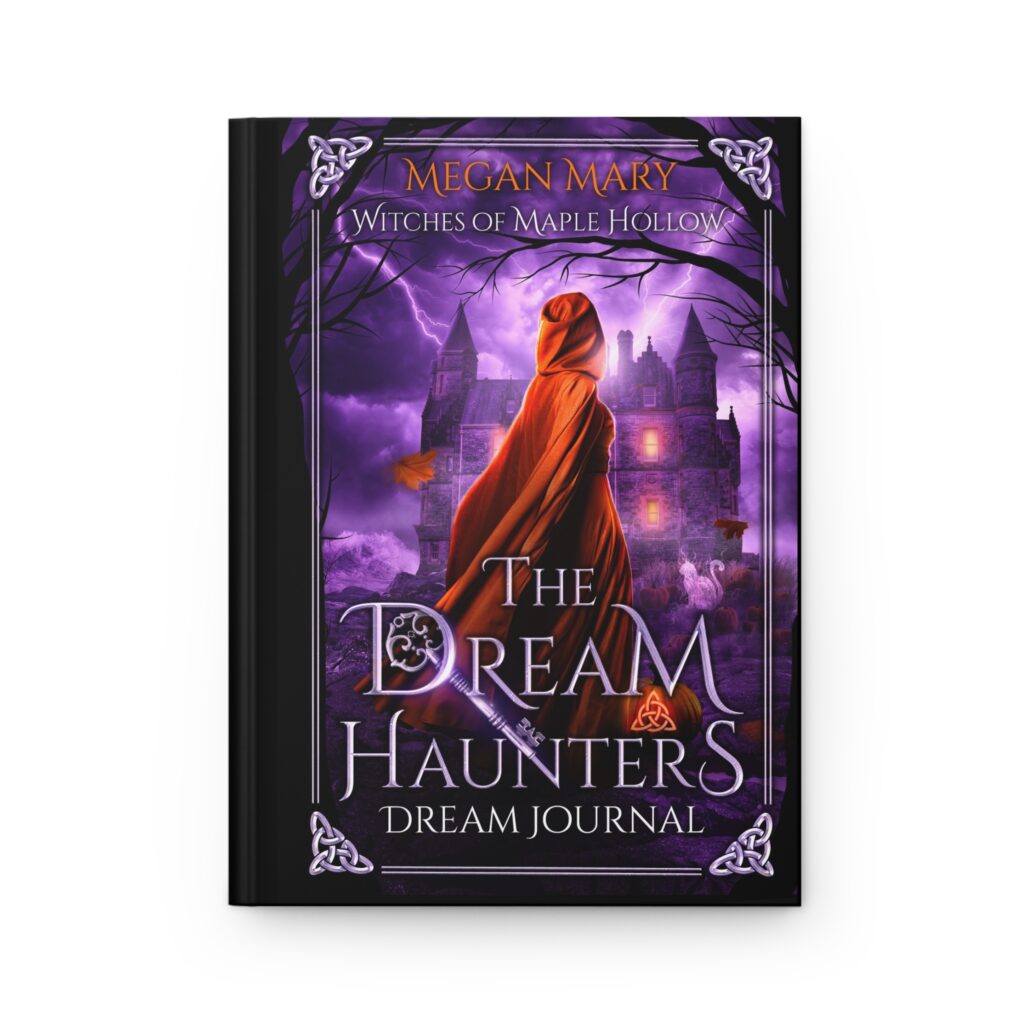
If you enjoyed our discussion and are interested in more inspirational insights, I invite you to consider a dreamwork session and explore my international bestselling metaphysical trilogy, Witches of Maple Hollow.
Listen and subscribe on Apple Podcasts, Spotify, Stitcher, iHeart, Pandora, Amazon Music, TuneIn, Podchaser, or on your favorite podcast platform.
Links
Follow Megan
- YouTube
- Threads
- Tiktok
- InsightTimer
- Bluesky
- Alignable
- Audible
- Amazon
- Books2Read
Follow Traci
Traci and Melissa
[00:00:00] to inspire your personal enlightened journey. I’m your host, Megan Mary, international best-selling metaphysical author and founder of Inner Realms Publishing. Let’s bring in the light.
Megan Mary – MeganMary: Welcome.
Speaker View: Today we have
Megan Mary – MeganMary: Traci
Speaker View: Medford-Rosso
Megan Mary – MeganMary: and Melissa Plush. Traci
Speaker View: Medford-Rosso is an intellectual property attorney and USA Today best-selling author of four books. She lives and works in New York City. Melissa Plush, pen name Maggie Wright, is a co-author
Megan Mary – MeganMary: with Traci
Speaker View: of the bestseller Unsheltered Love: Homelessness, Hunger, and Hope in a City Under Siege, and Chasing Light: [00:01:00] Two Women, Their Mothers, and a Secret That Changed Their Lives. Maggie lives in Brooklyn with her partner and two beloved cats.
Megan Mary – MeganMary: Welcome, Traci
Speaker View: and Melissa.
Thank you. Thank
MelissA Plush: having
Speaker View: you.
for having us.
Yes. I’m really glad to have you both here. This is only the second time that I have had two guests at once, and
Megan Mary – MeganMary: it
Speaker View: really
Megan Mary – MeganMary: en-
Speaker View: enhances the dynamic of our conversation, so looking forward to this. Okay, so my first question that I start every episode with is, what does enlightenment mean to you?
Megan Mary – MeganMary: And Traci,
Speaker View: I’ll have you go first.
If you wanna, if I wanna quote the first line of Eckhart Tolle’s Tolle’s book, The Power of Now, but I think enlightenment to me means
when consciousness is identified with the divine [00:02:00] self as opposed to the temporary ego construction, which is our particular incarnation. Yes. So I actually think you can come in and out of enlightenment, if you will at least to the extent that I have found that it’s a gradual process of disidentification of my consciousness with the temporary form, which is the ego, and connection to my higher self or the divine consciousness.
And so for me, at the stage of where I’m at, I spend time in, with my consciousness attached to both my divine self, my higher self, and as well as my ego identity for this particular lifetime, which is
Traci: Traci
Speaker View: Fair enough, yes. answer is different. Okay, Melissa,[00:03:00]
MelissA Plush: Oh,
Speaker View: Oh, boy. does enlightenment Mean to
you?
Well, mine’s a little different. I I– Enlightenment to me, really, I feel like I never knew, I think, how good I,
MelissA Plush: quote,
Speaker View: quote, “had it” until I lost everything. And the enlightenment for me came when I realized that Even though you can fall to literally the bottom of where you
MelissA Plush: can
Speaker View: be. Like, you know how
MelissA Plush: how
Speaker View: when they say you hit rock bottom? I felt like I was beneath the rock bottom. But the enlightenment came when I realized that wasn’t the end for me, and there was something else for me to work towards. And that,
MelissA Plush: to me
Speaker View: was that enlightenment, that this wasn’t the end of my life. Most people, unfortunately, not to sound like this, but they never get off the street. The enlightenment for me came when I said, “I don’t have to stay here forever. I can be better.” And that is what was the enlightenment for me, that there was [00:04:00] more for me in life than what was in front of me, and that it was my choice to seek it and go forward and find it.
Okay. Yes.
Megan Mary – MeganMary: And
Speaker View: I’m gonna give a little backstory now about how you two met. In the Book Unsheltered Love, it is a firsthand report of how the pandemic exacerbated
Megan Mary – MeganMary: the
Speaker View: homeless situation in New York City. And in that story, there are probably 50 homeless people that, that
Megan Mary – MeganMary: Traci
Speaker View: came to know very well,
Megan Mary – MeganMary: y-
Speaker View: but you were one of them.
Yes.
So one of you, one of you can tell a little bit of that backstory, and then I’ll, and then I’ll tell about your second book
They call New York City the city that nev- that never sleeps. So for a homeless person, that’s beneficial because when you’re begging on the street [00:05:00] for money, when there’s people on the street 24 hours a day, seven days a week, that ups your odds of getting a hot meal or a cup of coffee. So when the pandemic hit, that took away that.
MelissA Plush: The
Speaker View: city that never
MelissA Plush: sleeps
Speaker View: was silent. So there was nothing. It was just desolate, and it, it was, it looked like an abandoned city.
MelissA Plush: I
Speaker View: had never in my life seen Park Avenue without a car going. There was not a taxi, not anything. So when
MelissA Plush: Traci
Speaker View: appeared on the street, she was like a mirage.
It was like, “What are you doing here?” This doesn’t seem to fit. But she was there every day like clockwork. Every day.
That’s an amazing story. And I have just almost finished reading Unsheltered Love, and it just walking through that time period with you and remembering what [00:06:00] it was like. Traci, tell us a little bit about what made you decide to step out of your safe home and go out onto the streets of New York?
So I was in Turks and Caicos when I got the news that there was this major thing happening in the world, and I didn’t really pay that much attention to it until we got the notice that the borders were closing. The airport was closing. The borders were gonna close in Turks and Caicos. So I had to come back to New York City, and
Traci: th-
Speaker View: that was really the first binary choice that I had to make.
I could have stayed in Turks and Caicos, which my daughter wanted us to do i’m 70, so back then I was w- 64. My husband is four years older. So we were in that age group where we were at risk, and my daughter wanted to stay in Turks and Caicos ’cause she thought we would be safer.
But my son wanted us to come back. Maybe it was the other way around. It doesn’t matter. We decided to come back. And when I came back to New York City, it was, as Melissa described it, it was a [00:07:00] ghost town. It was devoid of life. There was no noise. There were no human beings. There was nothing.
And the very first day I got back, that very first night I live in New York City on the dead center in the middle of New York City on 38th and- which is just four blocks south of Grand Central, which is literally the center of Manhattan, the long, skinny island. And there’s a church right across the street, and I saw homeless people bedding down for the night, and I think that was my first conscious awareness that, wow, they don’t have any place to go.
We were under shelter in place orders. Everybody was s-
Traci: only
Speaker View: to leave their homes to get food or medical attention. And the next morning I went to the grocery store, and it hit me again that the homeless people were left on the streets. And I came back
Traci: to
Speaker View: my apartment and I said to my husband Joel, “
Traci: They’re “
Speaker View: They’re [00:08:00] gonna starve to death because they’re dependent on panhandling.
That’s how they survive. And there are nobody, if there’s nobody on the street, there, there’s no way for them to panhandle.” And I said, “Again, this is our second binary choice. We’re either gonna stay at the, in the safety of our apartment and order food-” And wait for this to be over, or we’re gonna try to do whatever we can to help.
And I said, “It’s one or the other.” And I said to Joel, “I don’t think I can… I’m not gonna be able to live with myself
when it’s over if I don’t do something to help.” So we started making sandwiches. Uh, And we got up every morning and
Traci: we
Speaker View: looked like two Santa Claus bags hanging us. We had sandwiches and water and granola. And we started walking, and we walked until we couldn’t walk [00:09:00] anymore, and
Traci: I
Speaker View: was getting b-
Traci: small
Speaker View: of money out of the cash machine.
And we just walked until our bags were empty or our legs gave out. And my husband is a therapist and I’m an attorney, so after we got home, I went to… I had my own office at this point. I had wo- I
Traci: I
Speaker View: had worked for a corporation for 30 years, but at this point I was in private practice with one other person.
So I was allowed to go into my office ’cause there was just two people. And Joel did all of his therapy on Zoom, and it was during this time that I met Melissa. So she only lived eight blocks south of me. She lived on Park Avenue and 30th. I live on Park Avenue and
Traci: and 38th.
Speaker View: Must have passed her hundreds of times, but I never noticed her because when the city is so full of,
Traci: life,
Speaker View: I don’t know if you’ve ever been to New York City, but it’s pulsating with life.
There, there’s only so much your brain can take in. But when it was empty, then the homeless [00:10:00] people stood out because of their presence, and I got to know homeless people, and I realized, and this was part of
Traci: o-
Speaker View: o- one of my aha enlighten- enlightenment sort of portals that I went through.
I, It’s more portals for me as opposed to a single moment, was I realized after, pretty quickly after maybe a month of getting to know Melissa and talking to her, that we were very similar. The surface was very different.
Traci: First
Speaker View: all, I’m 25 years older, just for starters. But I just said, know, “She’s homeless and I’m an attorney and I’m living in the lap of luxury.
She’s on the street corner.” But despite all of those surface differences, I realized there was not that much difference at all between the two women. And I just made it a point every day of going down and,
Traci: gave her
Speaker View: some sandwiches and some money, and
Traci: little
Speaker View: by little we got to know each other.
We, we started to talk about things that were important to us, and that’s where we started to talk about our mothers. And, she confided to me [00:11:00] things, and I confided to her things, and she became one of my best friends. And she’s still one of my best friends. Yes, I am.
And I,
MelissA Plush: The
Speaker View: I realized that there was an amazing story to be told about what was happening in New York.
Not just what was happening to the homes, but just the whole
Traci: thing that
Speaker View: was happening in New York City because we were the epicenter. We were the first place where the COVID virus took hold
and- and there were ambulances on every street corner. There were refrigerated vans everywhere you looked.
It was a very intense war-like place to live at the beginning of the pandemic, in those first six to eight months of the pandemic. And through my relationship with Melissa, I started to awaken to the to the realization that we really are all [00:12:00] connected and that we are all the same
Traci: a-
Speaker View: a- as soon as you look below the surface.
We’re a very visual species and we look on the surface. And I was as guilty of that as anybody on the planet,
Traci: playing
Speaker View: in the external world, always trying to,
Traci: be, get
Speaker View: good grades in school and then go to law school and blah, blah, blah.
And then I, at that point because the external world had died on us, I started to look inside. There’s really no place else for me to look at that point because everything had really literally been stripped away. And then that’s what made me realize, wow, Melissa and I, we’re just two women.
We have our hopes and our dreams and our struggles and our difficulties, but we’re just two women. And that was the beginning of,
Traci: wanting
Speaker View: to write the story. And it was a, it was an interesting transition with Unsheltered Love because at first I wrote it from my perspective, and I had a really good agent and she put it out to 35
Traci: 35
Speaker View: publishers and it was rejected across the board.
A- [00:13:00] Always for the same
Traci: reason.
Speaker View: reason. They said, “We don’t wanna hear from a privileged white woman about homelessness.” So I talked it over with Melissa I said, “
Traci: It’s
Speaker View: rejected.” She goes, “Why don’t I add my perspective so that the story really is the perspective of two women from two, from two sides of the sidewalk?”
And so f- that’s the, that’s what we did with Unsheltered Love, and she wrote after every chapter a journal entry which explained her side of the equation, if you will. And then that was then resubmitted and
Traci: it
Speaker View: was snatched up and it became an,
Traci: Wall
Speaker View: Street Journal, USA Today bestseller.
But the main award that it got was it won the grand prize for the Eric Hoffer- Contest which had over 10,000 entries in it. So it was recognized,
Traci: as
Speaker View: a significant literary achievement. And it was really due to Melissa, because before she wrote her journal entries, the only thing I had to show for Unsheltered Love was a stack of [00:14:00] rejections taller than my desk.
And
Traci: that’s
Speaker View: what I
Stop it
That’s true. It is the truth. This is
Traci: truth. This
Speaker View: what I got on my own for Unsheltered Love. Oh. But with her addition, it took it to a different … And so that just, again, was like another sort of portal I went through about how the connections between us make each of us greater and stronger than we are individually.
Mm.
Traci: So
Speaker View: Yes.
that’s-
that’s wonder- that’s wonderful. Yeah. I have a line that I’d like to read from that book that I, because I was reading it last night, and that is, “The lines between the homeless and myself started to blur. I knew we were distinct physical entities, yet I started to feel an intermingling below the surface of the exterior world that connected us at a fundamental and far more profound level.” Yep. Yeah. And I think
Megan Mary – MeganMary: that’s
Speaker View: a beautiful way to present it, from both sides. Yeah. It gave so much reflection, and it gave so much [00:15:00] wholeness and duality to the story. And for you, Melissa how was that to be able to contribute to your own story in that way?
Megan Mary – MeganMary: う
Speaker View: is an English teacher, and I’ve always been a writer, and I’ve always, written. So this was a real chance for me, people would… I would sit on the corner and beg for money, and people would walk by me. They wouldn’t even let me pet their dogs, and they just assumed that I was the worst of the worst. So to have the opportunity to use my voice to tell my story and explain that- what you think you see is not what you really see. And I’m guilty of that myself. When I was f- When I first became homeless, every night I would sleep on the sidewalk, and there was a [00:16:00] man that would walk by, and he would drag a garbage can behind him, and I was terrified of him. And I never saw him in my life, but I was just afraid of him. And months went by, and after a while he would nod at me or wave and we started talking, and he told me that he had a master’s degree from the University of Virginia in mechanical engineering. And I was like, “What?” And he dove into his garbage can and pulled out his wrinkled diploma, and then pulled out his identification. And he’s “I swear, this is who I am.”
MelissA Plush: He’s “
Speaker View: It’s not who I am right now, but this is who I used to be.” And I never forgot that, because here I was, afraid of this man, and
MelissA Plush: he
Speaker View: was just trying to survive the same way I was trying to [00:17:00] survive. So it gave me this perspective that you even an enlighten-
MelissA Plush: just
Speaker View: like who am I to judge anyone?
I’m out here looking at everyone judging me. Meanwhile, I’m doing the same thing, and that kind of gave me this new perspective and it really changed my life, if you will. And I have tried to pride myself on that ever since then. I have done the best I can not only to advocate for the homeless, but to educate other people when they make comments. Even my mother, walking, I take her to the CVS, there’s somebody begging outside and she walks by. And I’m like, “You didn’t even look?”
MelissA Plush: Because
Speaker View: I’ve been there. It’s easy to overlook things when you don’t understand that. But if you take the time to kinda look around and assess the situation and get to know people, [00:18:00] the same way
MelissA Plush: Traci
Speaker View: took the time to get to know me, there’s like a whole world under the surface that you’re not seeing.
Yeah. And I really appreciated that
Megan Mary – MeganMary: Traci
Speaker View: told the stories of how each person came to find themselves in that situation. What started at the very beginning for you, I believe it was that you had a root canal.
Megan Mary – MeganMary: Is that
MelissA Plush: Yeah. I
Speaker View: Is that correct? Yep. I had a root canal. I was living in New Jersey. I was working. I was married. I had my two children, and I had a root canal. And I did what everybody else does. You go to the dentist. They gave me the root canal. They gave me medication. Now, remember, this is years ago, before the opioid epidemic really became a thing in the news, or when anyone was ever paying attention to it. So they gave me the medication. I took it. I went back to work. and then I got a dry socket, which sometimes happens when you get a root canal. And I went back to [00:19:00] the
MelissA Plush: dentist and
Speaker View: they gave me more medication, and the next thing I knew- That was it. It was only two and a half weeks, and I was just literally cheer mom, class mom, working every day, cooking dinner every night.
I was your normal,
MelissA Plush: normal,
Speaker View: typical subur- I drove an SUV, I drove the carpool, and from one minute to the other, just my life changed.
It’s so humbling I- …to hear these stories, and it does make you recognize just how fragile life is and how unpredictable life can be, and how anyone can
In a set of circumstances like the stories
MelissA Plush: know, and you know, and it… When I was married, my ex-husband, he always wanted to go camping, and I said, “Absolutely not. I don’t sleep [00:20:00] outside. I will not go to the bathroom in the woods. That’s not my thing.” And then years later, I found myself sleeping on the sidewalk, and during the night I laughed at myself, like, how I was How could I say such a thing? That was be- that was beneath me, and now that was my entire life.
Speaker View: It was the most humbling, enlightening thing that could have ever happened to
MelissA Plush: Because
Speaker View: things that used to matter to me do not matter to me. I don’t have fancy purses. I don’t wear makeup.
I don’t wear fancy clothes. I take care of my family. I do my work. I take care of my dog. I- that’s it. Things that used to matter, it’s- it changed my life because the things that people think that are important, they’re not important. Right. What’s important is your own [00:21:00] peace and being comfortable with who you are, accepting who you are, accepting your faults, and knowing what you can do to be better tomorrow. ‘Cause tomorrow is always another day, and you can always be better
MelissA Plush: tomorrow
If you are enjoying my podcast and are intrigued by dreams and stories of spiritual awakening, I would like to personally invite you to explore my international bestselling metaphysical trilogy, Witches of Maple Hollow. Like a mystical fairy tale, these fall-themed mysteries weave cozy supernatural fantasy into enchanting tales of magic and self-discovery.
Start with book one, The Dream Haunters. The Book Life Prize calls it, “Packed to the brim with surprise portals, ancient traditions, and dream worlds.” [00:22:00] Then dive into the elusive nature of reality in The Dream Mirrors. And finally, unravel ancestral riddles beyond time and space in The Dream Dimensions. Get your exclusive signed copies today at meganmary.com.
Stop by the store while you’re there and grab your dream journals, cozy blankets, pillows, candles, and more. And don’t forget, they also are available in audiobook. Come visit me in Maple Hollow
Speaker View: And guys went on to write a second book. There is a sequel to The Unsheltered Love called Chasing Light, and Yes …that’s a lyrical meditation on grief, memory, and the fragile beauty of everyday life. And at its core is [00:23:00] the story of resilience, forgiveness, and the transformational power of human connection. And I like how the storyline is split between asleep and awake. Talk a little bit about that.
So both of us, I think, were still in, yeah, asleep when we first met, Yeah. different reasons. Melissa was more just because she was into survival mode, and I was still connected to the outside world. And not to say that I’m not now, but I was,
Traci: very,
Speaker View: and I was always a nice person, so Enlightenment isn’t about being nice. I, but I was very much trying to get good … First,
Traci: it
Speaker View: started I get good grades in school, and then go to law school, then get a good job,
Traci: blah,
Speaker View: blah, blah,
blah. So during the first part of the pandemic, which is really captured in the first Unsheltered Love, I was in a [00:24:00] rapid acceleration of awakening.
It had started actually before I even met Melissa, and and COVID hit. But it was very dormant.
Traci: The
Speaker View: awakening process in me was very dormant. Suddenly, it was very accelerated, and it was almost like every day, and certainly every week, more and more realizations were coming to me.
And the reason that we wrote the second book was because of our mothers. And this
The binding factor. So- One of them but
MelissA Plush: them,
Speaker View: we both
Traci: had
Speaker View: difficult situations with our mother. Very … Different,
MelissA Plush: but
Speaker View: the same
My, my mother was a Valium addict. She was also as Melissa was, a victim, if you will, of
Traci: the
Speaker View: age where you didn’t where in her case it was the opioids. They just [00:25:00] didn’t realize how addictive they were, and they were giving them out certainly for root canals.
Traci: And,
Speaker View: and my mother’s case, she was a Valium addict back in
Traci: back
Speaker View: the day where, … there was an advertisement in 1952 so my mother was one of those victims, and we both started to realize that while we had indeed had some suffering as a result of different aspects of our relationship with our mother, that I started to realize that I thought Melissa was even more injured than me.
Because despite that my, the fact that my mother was a Valium addict and not present in my life, and committed suicide six weeks before my wedding, that my mother never once, ever, said a mean word to me. It was such a start. I was like, “Wait a minute. How can Melissa be more injured than me?” And my mother also hit us.
I don’t think that was that unusual, ’cause I grew up in Virginia and everybody was getting spanked. But,
Traci: my,
Speaker View: my mother didn’t, was prolific use of what I call the [00:26:00] dreaded black belt. But that wasn’t the main thing that injured me. It was her absence, because she was a, such a,
Traci: she
Speaker View: was addicted to Valium from the day I was born, because when I was born, it shattered her lower spine.
So and then of course the suicide, which is a very difficult thing. When a parent, and I can’t even imagine if, what people go through if their child commits suicide. It’s a very difficult thing to get your mind around, because even though intellectually you know it has nothing to do with you, you still feel rejected.
You still feel like my mother only had one daughter. It’s me. How could she commit suicide six weeks before her only daughter’s wedding? And for years I used to go around saying, “Whose mother does that?” And I was very much attached to the identity of the victim of having a mother who committed suicide and blah.
And then I, and then at some point w- listening to Melissa tell me uh, her story, I was like, “My mother never once never once said to me, [00:27:00] never once said to me, ‘You can’t do this. You’re unworthy. You’re, you’re you’re not good.’” So au contraire, when I grew up, I was, grew up in the cornfields of Virginia, and when I announced at age 16 I was gonna go to law school,
She said, “Go for it. You’re smart.” There was only five women in my law school class. I It wasn’t a thing that women did back,
Traci: i’m
Speaker View: 70. I’ll be 71 next month, so I don’t know how many years ago. half a century ago I was in law school, right? But nobody, she was like, go.
You go, girl.” She never, nobody, she never belittl- she never commented on the way I looked. She never made me feel like that I,
Traci: that
Speaker View: I wasn’t … Nothing. There was no denigration whatsoever. So I started to realize- Okay, she was a I drew a short straw. There’s,
Traci: no
Speaker View: sugarcoating the fact that if your mother becomes a Valium addict and isn’t a present and then commits suicide, it’s not a good straw to draw as a mother.
But Melissa suffered a lot more in, in much more subtle ways. And then the same thing was happening to Melissa, and one day she said to me, I’m so ashamed of [00:28:00] myself for complaining that my mother’s not nice to me or d- you know. My mother’s still here. My mother’s still…” Despite what I put my mother through, which is three years of not even knowing where her daughter was.
Her mother didn’t even know if her daughter was alive. What I put my mother through, she welcomed Melissa back with open arms when Melissa showed back up after three years of living on the street. And was there for her. So Melissa said to herself maybe I didn’t have it so bad.”
And that’s the secret.
Traci: That was the secret
Speaker View: Yep. that was the secret that changed our lives because we both realized… and not to mitigate it. It’s not to try to say, “Oh
Traci: I
Speaker View: had such a great…”
It’s no contest.
But it was…
It’s not a contest.
Exactly. There was, she, her suffering was every bit as great, a- and as my… And so that kind of a… And then we both were also w- awakening and realizing that wrong, good or bad, being in a victim mentality, ’cause now I’m starting to understand more about
Traci: just
Speaker View: energy
MelissA Plush: Right
Speaker View: and the way energy vibrates and the way [00:29:00] we individually vibrate and what we attract.
And as Einstein said, this isn’t religion or spirituality, it’s physics. Because everything is energy and everything has vibrations that attract similar vibrations. If you’re in a victim ment- which I was my whole life, then you’re only gonna attract more things to be victimized about. So
Traci: you
Speaker View: you might as well pull your pants on, girl, big girl pants on and get over it.
MelissA Plush: put
Speaker View: your big girl panties on
and just- Yeah. Be yourself. E-
Traci: Even if
Speaker View: it’s true,
Traci: it doesn’t
Speaker View: matter. It’s bec- it’s I don’t wanna be setting up the perfect scenario for the universe to send me more things to be victimized about, which I was doing my entire life Right
Traci: because
Speaker View: because I was so attached, my ego was so attached to the victim mentality of having a mother who committed suicide.
Only I could set myself free from that, and I did because I met Melissa
Okay. Wow. I’m gonna have to read that next. [00:30:00] Yes
MelissA Plush: Yes
Speaker View: So powerful.
Megan Mary – MeganMary: It’s
Speaker View: so beautiful what you both provided for each other, and what you discovered as a result of each other’s story. Just recognizing Right …that you’re not alone in your struggles, but that also you have the choice of how you define yourself. And so often we let our circumstances define us, or our family, or our teachers, or our friends, or the media, or social media, or what we perceive is the accepted way to be Yeah or to act, and those things are all programs. And once we realize that they’re all programs, it breaks, it starts to break the surface.
Exactly
I was begging on that corner [00:31:00] for all those years, I would sit there and I would watch people walk by, and I would just say, “How lucky are they?”
MelissA Plush: They are
Speaker View: going to their job, or they’re on their way home, or they’re walking their dog. They have their keys in their hands. I was like, “How come I don’t have keys? How come I’m not walking my dog? Like, why does everybody have somewhere to go but I don’t?” And I found myself sitting there feeling so sorry for myself. And then I realized most of these people have the same problems that I do in just different ways. They might have a home to go to, but that doesn’t change that they’re miserable the same way that I am. And learning that and that gave
MelissA Plush: me this,
Speaker View: okay, we’re all in this together, so how do we work together and support each other so that we can all get [00:32:00] through all of this crap?
Yeah, it’s one of the biggest illusions of this reality is that money solves everything Right. Because there are people that are off in their castles with their millions of dollars and they’re completely empty inside they’re
And they have no one around them.
Yeah …even
Megan Mary – MeganMary: Yeah.
MelissA Plush: miserable than
Speaker View: I am because I’m on the sidewalk, but I have people that care about me. They’re obviously coming,
MelissA Plush: they’re…
Speaker View: They care about me. They’re
MelissA Plush: se-
Speaker View: seeking me out. They’re trying to help me. They’re trying to make me better. So I don’t know what these people have, and I found myself looking and being jealous of people, and I don’t know anything about them.
Who- I should be grateful that I’m here and I can do better, and I have the opportunity to not sit here forever. And that’s what I did, and that was my focus, that I don’t have [00:33:00] to be miserable and jealous and looking at these people. And now I have my own keys. I have my own dog. You I have a place to go when I leave the house. and that, just saying that is enlightening,
Yes.
Because I never thought So …I would ever be there.
MelissA Plush: When you’re
Speaker View: sitting on that corner with a cup in your hand, you never think anything will get better. You think you’re just gonna wake up the next day and it’s going to be the same, because that’s how it’s been for three years. But then one day it’s not, because something changes inside of you that makes you say, “I’m not doing this anymore. What can I do to change this?”
Yeah, and there were some people in that story that had been homeless for over 20 years.
Yep. Yep.
Yep.
And they taught me a lot, and not… I, I just I saw [00:34:00] what they went through, and I helped them, and we all helped each other. Mm-hmm. Of
MelissA Plush: Traci
Speaker View: helped, we were all off the street. Eventually, everybody found their way. At fir- whether they, whatever happened to them afterwards, but they found their way.
MelissA Plush: Traci
Speaker View: and Joel helped them find their way to something better. It’s their choice after that what they do
Yeah.
with their own life. Right. But if you’re given the opportunity, you make what it is. You make your life what you make of it.
Yes, and what an amazing opportunity that
Megan Mary – MeganMary: Traci
Speaker View: and Joel provided for all of those people. So
selfless-
MelissA Plush: me.
Speaker View: Oh, it’s,
MelissA Plush: And
Speaker View: me, and
me …and
compassionate. And me. Yes. To step out of when you didn’t have to, when you didn’t have to do that, but that you felt compelled to. And that was another one of the quotes. “
Megan Mary – MeganMary: Determination
Speaker View: propelled me forward in an effort to help them to a place where [00:35:00] compassion trumped logic and courage dissipated fear even when the outcome was uncertain.” And there were so many times where you said, “I don’t know if I can continue to do this.
Megan Mary – MeganMary: What am
Speaker View: I doing? I don’t belong in this realm. I’m endangering myself. I’m off the rails here doing this.” But you followed your heart, and your heart was telling you, “This is what I need to do.”
And that, that selflessness and that compassion became a domino effect that just affected so many lives you probably don’t
even know it,
I have to say, Melissa’s very modest, but we got every single person off the street, and Melissa was right there helping. You remember Angel, Yes …Melissa? Of course
I do. Melissa, Melissa was
MelissA Plush: But…
Traci: was
Speaker View: instrumental because she was the bridge between, for us
Traci: to
Speaker View: the agencies. So one by one, every single person in…
And I’m gonna send you, I have another, I have a little video [00:36:00] like w- what I sent you with just Melissa of all the rest of them. So I’ll send you that too, and maybe Melissa will make that into a YouTube video you can embed.
I
will. Of course. They’re, they’re very short. They’re only, 20 seconds, but you’ll see some of the characters in the book.
But I, before we go, ’cause I know we’re already past our time, I just have to say something about Melissa. So Melissa is the only known person in the state of New York who has ever lived on the street- There are five levels of homelessness. I didn’t know this until I, and I write about that in Unsheltered Love.
Traci: ‘Cause you’ve got couch surfing, you’ve got, the shelters, you’ve got the
the
Speaker View: what we call the safe haven rooms, then you’ve got the low income housing. But the lowest level of the five levels is you’re on the street. Once you’re on the street, the chances that you’re ever getting off that street, one in a gazillion.
And but for the pandemic, I don’t know that Melissa would’ve gotten off the street. So the COVID was Yeah …a blessing for her and it was a blessing for me in the midst of a great deal of [00:37:00] suffering. But she has not only been the only person to ever get off the street, reintegrate into society, become housed.
She went back to college at the age of 40. She had dropped out 20 years before. She graduated, she got straight As her last year. She was so inspirational to all of her teachers that she was chosen best of Brooklyn College. That, I sent you that article. It’s a huge honor. It, I think they pick one graduate a year.
It’s a huge honor. Melissa was chosen. She’s now employed writing a memoir for the CEO of the Brooklyn Chamber of Commerce.
Traci: She
Speaker View: is
Traci: a
Speaker View: success and she’s, it, if you read Chasing Light you’ll know more about Melissa and what she did for her, what she’s doing for her family, what she did for her family.
But in her, she was almost graduated from college, and now this is something she was working for 25 years, and her mother called her up and she said, “Your father’s dying. I can’t take care of him anymore.” [00:38:00] Her mother’s very small. She’s very, like I don’t know if she’s 100 pounds, and her father was a big man, 250 pounds, and Melissa dropped out of college.
She was in her last semester. She dropped out of college, and she stayed by her father’s side until he took his last breath, which was in March of the following year, so she lost that semester. She, so she lost the fall semester, and she lost the spring semester. She never left her father’s side.
She was there when he took his last breath. She has done more for her family since she has been… I, I could go on and on. but This is an extraordinary woman.
Thank you. Thank
MelissA Plush: You.
Speaker View: you for sharing your story today. It’s it’s so inspiring to everyone, and it really shines a light on what’s possible and The Chasing Light in description says that
Megan Mary – MeganMary: it
Speaker View: it invites the readers to move slowly, to remember, and to bear witness to the light within us [00:39:00] all that endures. And you are both a testament to that light and to the power of awakening, the power of connection and just the power of human kindness.
So thank you both for being here today and
sharing. Thank you for having us.
You’re welcome. Yes.
Thank you
so, so much. It
MelissA Plush: Thank you
Speaker View: was
so
MelissA Plush: It was so
Speaker View: nice to talk to you. Thank you again.
Traci: And thank you
Speaker View: And thank you for sharing your books with the world too, Meg.
Yes, and I will put both of your information in the show notes. Traci, if you’d like to say your website, Melissa, if you have one, and then I’ll put them
Megan Mary – MeganMary: in the
Speaker View: show notes as well.
Okay. You want me to say it or I send it to
Traci: to
Speaker View: You Sure. You can say it, yeah.
Traci: you?
Speaker View: Just
Traci: TraciMedfordRosow.com.
Speaker View: tracimedfordrosso.com. Melissa doesn’t have a website, but she’s got a book and an Instagram.
Megan Mary – MeganMary: Okay,
Speaker View: great. And so I’ll put those in the show notes so people can follow you, and I’ll also have your, the links to your books as well. Thank you
both. Thank you so much.
Thank
you. so much. Have a nice day.
It was a pleasure.
Megan Mary – MeganMary: Thank
Speaker View: you. Bye-bye. Thank you
MelissA Plush: [00:40:00] you
Thank you for listening. Did you enjoy this episode? Be sure to subscribe to make sure you never miss an episode. Head over to my YouTube channel. and hit that subscribe button as well to be part of my growing community. Are you ready to take the next step in your spiritual journey?
Don’t miss out on the new Dream Empowerment Programs, unique opportunities for you to unlock your inner wisdom, discover your authenticity, align with your higher self, and bring abundance into your life. Your dreams have the power to inspire and enlighten other women on their journey.
Visit megan mary.com to find out more.
As an Amazon Associate I earn from qualifying purchases.